
Documentation Practice
Why API Documentation Matters: A Practical Guide

API documentation is the product interface developers use before they trust your API, while they integrate it, and when something fails in production. Good documentation reduces uncertainty at each of those moments. It explains what the API does, gets a new developer to a verified result, defines the contract precisely, and provides recovery guidance when the happy path ends.
That makes documentation part of the API product, not supporting material added after engineering is finished. A fast endpoint with an incomplete quickstart is still difficult to adopt. A comprehensive reference with no workflow guidance is still difficult to use. A polished portal with inaccurate examples is actively harmful.
This guide explains what effective API documentation contains, how to structure it, how to measure it, and how to improve an existing documentation set without rewriting everything at once.
API documentation matters because it reduces integration risk
An API consumer makes several decisions before sending a production request:
- Can this API solve the required use case?
- Can the team authenticate and complete a representative workflow?
- Is the contract predictable enough to build against?
- Can the team diagnose failures without waiting for support?
- Will the integration remain maintainable when the API changes?
Documentation supplies the evidence for those decisions. Marketing pages can describe capabilities, but developers need request fields, response states, limits, error behavior, security expectations, and examples that resemble their implementation.
Poor documentation increases risk in two directions. Prospective users may abandon an API that is technically suitable because they cannot verify it. Existing users may implement incorrect assumptions because the documentation leaves behavior ambiguous. Both outcomes are expensive, but only the second usually appears as a support ticket or incident.
The practical objective is not “more documentation.” It is less uncertainty around the tasks developers must complete.
What should good API documentation include?
A complete API documentation set normally has five connected layers.
| Layer | Primary question | Typical content |
|---|---|---|
| Orientation | What can I build? | Product overview, use cases, concepts, environments |
| Onboarding | How do I get a result? | Prerequisites, credentials, quickstart, expected response |
| Task guidance | How do I complete a workflow? | Integration guides, lifecycle guides, SDK tutorials |
| Reference | What is the exact contract? | Endpoints, fields, schemas, errors, limits |
| Operations | How do I run this safely? | Webhooks, retries, idempotency, versioning, troubleshooting |
These layers serve different reading modes. A new evaluator wants a short route to proof. An implementer wants a sequence. A developer debugging a 422 response wants an exact field-level explanation. Combining all three needs into one enormous reference page makes every reader work harder.
A useful overview establishes the mental model
The overview should define the API in concrete terms. Name the core resources, explain how they relate, state the base URL and environments, and show one representative use case. Avoid leading with company history or architecture that does not affect the consumer.
For an event-delivery API, a concise model might be:
- A delivery represents one event submitted to a destination.
- A destination is an HTTPS endpoint that receives events.
- An attempt records one delivery attempt and its response.
- A webhook signature lets the receiver verify authenticity.
Those definitions make the rest of the documentation easier to interpret. They also give search systems and language models stable entities and relationships to extract.
The quickstart must produce a verifiable result
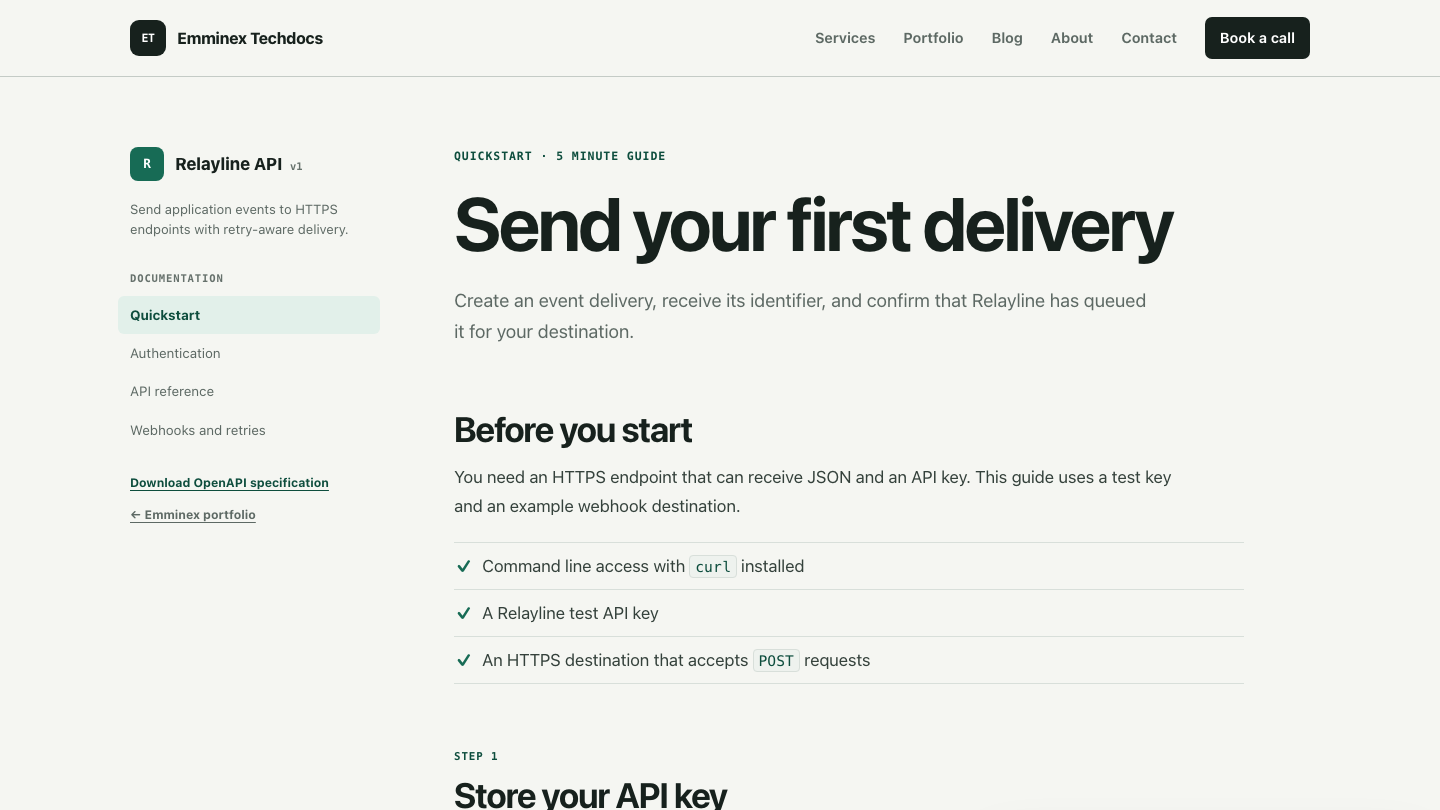
A quickstart is not a tour. It is a controlled path from zero context to one meaningful success. Keep prerequisites explicit, minimize choices, and include the expected response.
export RELAYLINE_API_KEY="rl_test_example"

curl --request POST \
  https://api.relayline.example/v1/deliveries \
  --header "Authorization: Bearer $RELAYLINE_API_KEY" \
  --header "Content-Type: application/json" \
  --data '{
    "destination": "https://example.com/webhooks/orders",
    "event": "order.created",
    "payload": {"order_id": "ord_7M2L9"}
  }'
Then show what success looks like:
{
  "id": "dlv_01J6Y3G8V9K2M4P7Q1R5",
  "event": "order.created",
  "status": "queued",
  "created_at": "2026-09-04T14:32:18Z"
}
Explain the status rather than assuming the reader knows it. In this example, 202 Accepted means the server accepted the request for processing; it does not mean the destination has already received the event. That distinction follows the semantics of the HTTP status code described by MDN’s 202 Accepted reference.
Reference documentation must describe behavior, not just fields
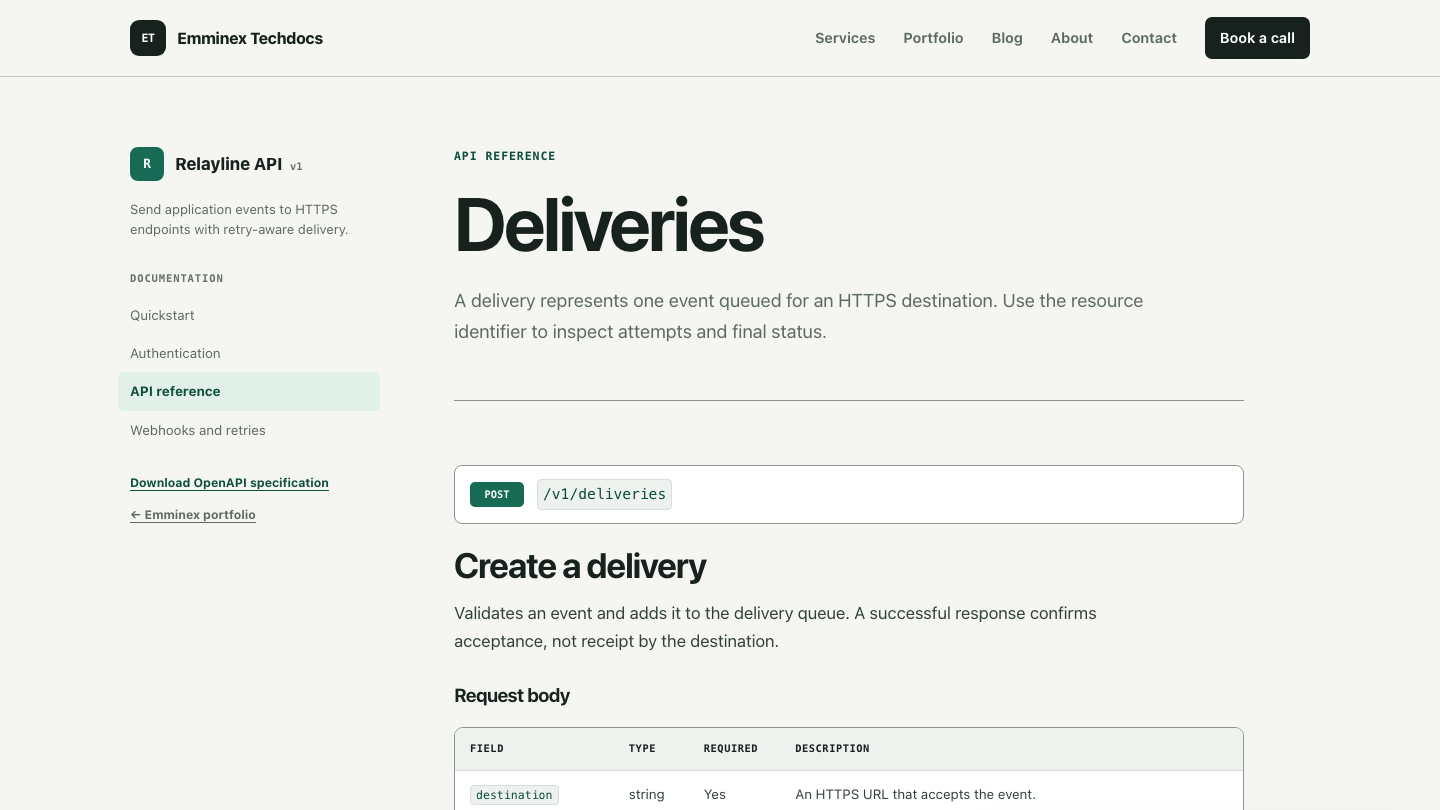
An API reference should answer four things for every operation:
- What the operation does and when to use it.
- What the caller must send.
- What the API returns in each important state.
- How the caller should respond to errors.
A generated table of parameter names and types is a useful foundation, but it is not enough. Consider a field called idempotency_key. A type of string does not explain how long the key is retained, what scope it applies to, or what happens when the same key is reused with a different body.
Write descriptions as contract statements. For example:
Prevents duplicate delivery creation for 24 hours within the current project. Reusing a key with a different request body returns
409 idempotency_conflict.
That sentence eliminates several implementation guesses. It also creates an answer that can be quoted accurately in search snippets or retrieval systems.
OpenAPI is a source of structure, not a substitute for guidance
The OpenAPI Specification provides a standard, language-agnostic way to describe HTTP APIs. A strong OpenAPI document can drive reference rendering, validation, SDK generation, contract testing, and review. It also reduces duplication because field descriptions and examples can be maintained close to the contract.
Here is a compact operation example:
paths:
  /v1/deliveries:
    post:
      operationId: createDelivery
      summary: Create a delivery
      description: Validates an event and adds it to the delivery queue.
      requestBody:
        required: true
        content:
          application/json:
            schema:
              $ref: '#/components/schemas/CreateDeliveryRequest'
      responses:
        '202':
          description: Delivery accepted and queued.
        '401':
          $ref: '#/components/responses/AuthenticationError'
        '422':
          $ref: '#/components/responses/ValidationError'
The specification can describe the operation, but developers still benefit from task-oriented pages that explain sequence and judgment: how to select a destination, how to store a key, when to retry, and how to verify a webhook. Reference answers “what.” Guides connect the “what” into “how.”
Treat generated reference and written guidance as one system. Link from a guide to the exact operation it uses. Link back from the operation to the common workflows. Reuse terminology and examples so the same resource is not called an “event” on one page and a “message” on another.
Error documentation is where trust is tested
Developers often read error documentation under time pressure. A list of HTTP status codes is not enough. Each error needs a stable machine-readable code, a human-readable message, likely causes, corrective action, and retry guidance.
{
  "error": {
    "code": "invalid_destination",
    "message": "The destination must use HTTPS.",
    "request_id": "req_01J6Y44C9N7Q2H5K8M3P",
    "field": "destination"
  }
}
Useful documentation for this response should say:
- Cause:
destinationuses HTTP, contains an invalid URL, or points to a blocked address. - Fix: provide a publicly reachable HTTPS URL.
- Retry: correct the field before retrying; automatic retries will repeat the same failure.
- Support: include
request_idwhen contacting support.
This structure helps humans and machines. A support engineer can search by request ID. Application code can branch on error.code. A language model can retrieve a bounded cause-and-resolution pair rather than inventing advice from a vague status.
Document rate limits and retry behavior with the same precision. State the unit, scope, reset behavior, headers, and recommended backoff. “Requests are rate limited” is not implementable guidance.
Examples should be executable, secure, and internally consistent
Code examples are promises. If the quickstart uses project_id, the reference uses workspace_id, and the SDK example silently obtains the value from configuration, readers must reverse-engineer which version is correct.
Use a small set of canonical example values across the documentation. Test examples from clean environments. Avoid secrets that resemble production credentials. Explain where configuration comes from. Show the complete import or initialization required to run the sample.
For an SDK, prefer a short complete example over a fragment:
import { Relayline } from '@relayline/sdk';

const relayline = new Relayline({
  apiKey: process.env.RELAYLINE_API_KEY,
});

const delivery = await relayline.deliveries.create({
  destination: 'https://example.com/webhooks/orders',
  event: 'order.created',
  payload: { order_id: 'ord_7M2L9' },
});

console.log(delivery.id, delivery.status);
Add the runtime version when compatibility matters, and test what the reader will actually copy. A syntactically valid snippet can still be unusable because it omits installation, environment setup, permissions, or the final verification step.
API documentation should be designed for search and retrieval
Developers arrive through site navigation, web search, support links, IDE assistants, and AI answers. The same documentation can serve those entry points when it is structured around clear questions and stable facts.
Use one descriptive H1 per page. Give sections specific headings such as “Verify webhook signatures” rather than “Security.” Define important terms close to first use. Keep related facts together. Provide examples immediately after the contract they illustrate. Use tables for repeated fields, but explain important behavior in prose as well.
Do not create unnatural pages for every keyword variation. Google’s current guidance for generative search continues to prioritize crawlable, original, people-first content over special “AI optimization” tricks. It specifically recommends clear technical structure and useful, non-commodity content in its guide to generative AI features in Search.
For ChatGPT search eligibility, public pages should allow OAI-SearchBot, according to OpenAI’s publisher guidance. Crawler access makes discovery possible; it does not guarantee that a page will be selected. Clear sourcing, stable URLs, accurate metadata, and answers worth citing remain more important than adding an llms.txt file with no content strategy behind it.
How to measure API documentation quality
Page views tell you which pages receive traffic, not whether the documentation works. Combine behavioral, product, and support signals.
Activation signals
- Time from account creation to first successful request.
- Quickstart completion rate.
- Percentage of new projects that reach a meaningful API event.
- Failure rate for the first documented request.
Support signals
- Tickets associated with documented tasks.
- Repeated questions that indicate findability problems.
- Errors that frequently require human explanation.
- Time engineers spend answering integration questions.
Content-quality signals
- Search queries that return no result.
- Pages with high exits during a multi-step workflow.
- Broken examples found by automated tests.
- Documentation changes shipped with product changes.
- Task-test success rate with representative developers.
Define each metric carefully. A shorter time to first request is useful only if the request represents genuine progress. A lower ticket count can mean better documentation, but it can also mean fewer users. Review signals together and record what changed before attributing an outcome to documentation.
A practical API documentation improvement plan
You do not need to rebuild the entire portal to make progress. Start with one high-value developer journey.
- Choose the journey. Authentication plus the first meaningful API operation is usually a good candidate.
- Walk it as a new user. Use a clean account and environment. Record every missing prerequisite, ambiguous choice, and failure.
- Confirm the contract. Reconcile the implementation, OpenAPI description, SDK behavior, and existing pages.
- Repair the quickstart. Put setup, request, expected response, and verification in one path.
- Complete the linked reference. Document fields, examples, errors, limits, and lifecycle states used by the journey.
- Test the examples. Run commands and code against a controlled environment.
- Add maintenance ownership. Identify which product changes require documentation review and who approves them.
- Measure the journey. Track activation and support signals before and after release.
This bounded approach exposes systemic problems without turning improvement into an endless migration. Once the pattern works, reuse the page templates, test approach, and review criteria for the next journey.
API documentation checklist
Before publishing an API documentation set, verify the following:
- The overview defines the API, audience, resources, and environments.
- The quickstart produces one meaningful, verifiable result.
- Authentication includes complete examples and secure storage guidance.
- Every operation documents purpose, inputs, responses, and errors.
- Schema descriptions explain constraints and behavior, not just data types.
- Examples use consistent fields and values across guides and reference pages.
- Webhook documentation covers verification, acknowledgements, retries, and idempotency.
- Rate limits include scope, units, headers, reset behavior, and retry guidance.
- Versioning and deprecation policies tell developers what will change and when.
- Search, navigation, and cross-links support both task and reference reading.
- Code examples are tested in the environments they claim to support.
- Product releases include documentation acceptance criteria.
Frequently asked questions
What is API documentation?
API documentation is the set of guides, reference pages, examples, and operational instructions that explain how to evaluate, integrate, and maintain an API. It normally covers authentication, resources, endpoints, request and response schemas, errors, limits, webhooks, SDKs, and versioning.
What is the difference between an API guide and an API reference?
An API guide explains how to complete a task that may involve several operations. An API reference defines the exact contract of individual operations, fields, responses, and errors. Effective documentation links the two rather than forcing one page type to do both jobs.
Can API documentation be generated from OpenAPI?
OpenAPI can generate a strong reference foundation, but it does not replace onboarding, concepts, workflow guidance, troubleshooting, or implementation judgment. Generated output is only as accurate and complete as the underlying specification.
How often should API documentation be updated?
Update documentation whenever observable API behavior changes. Documentation review should be part of the same release workflow as contract, SDK, authentication, error, and lifecycle changes. Scheduled audits can catch accumulated findability and consistency problems.
Build documentation developers can trust
Good API documentation makes the product easier to evaluate, integrate, operate, and support. The work begins with accurate contracts, but it succeeds through task-focused structure, tested examples, explicit recovery guidance, and a maintenance process tied to engineering change.
Explore the Relayline API documentation sample to see these principles applied across a quickstart, authentication guide, reference, webhooks, and an OpenAPI specification. If your existing documentation has unclear priorities, a focused documentation audit can turn the highest-impact gaps into an implementation plan.